45 years’ experience  ·  Rated 4.9 on Google  ·  Family-run, from our workshop near Wellington

45 years’ experience · Rated 4.9 on Google · Family-run

Floor Sanding and Wood Floor Restoration in Horsham

Careful sanding, repairs and colour work for Horsham’s timber-framed town houses, family homes, pubs and shops, from a Somerset family firm.

QUICK QUOTATION

Floor Sanding Taunton

Floor Sanding in Horsham's Old Town: Wide Boards on Moving Frames

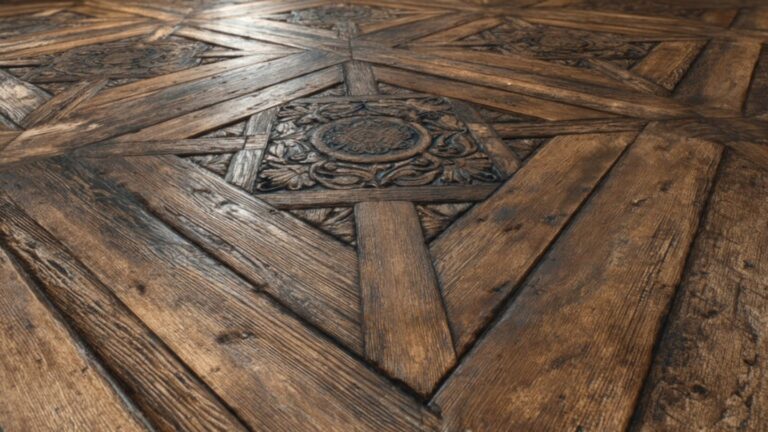
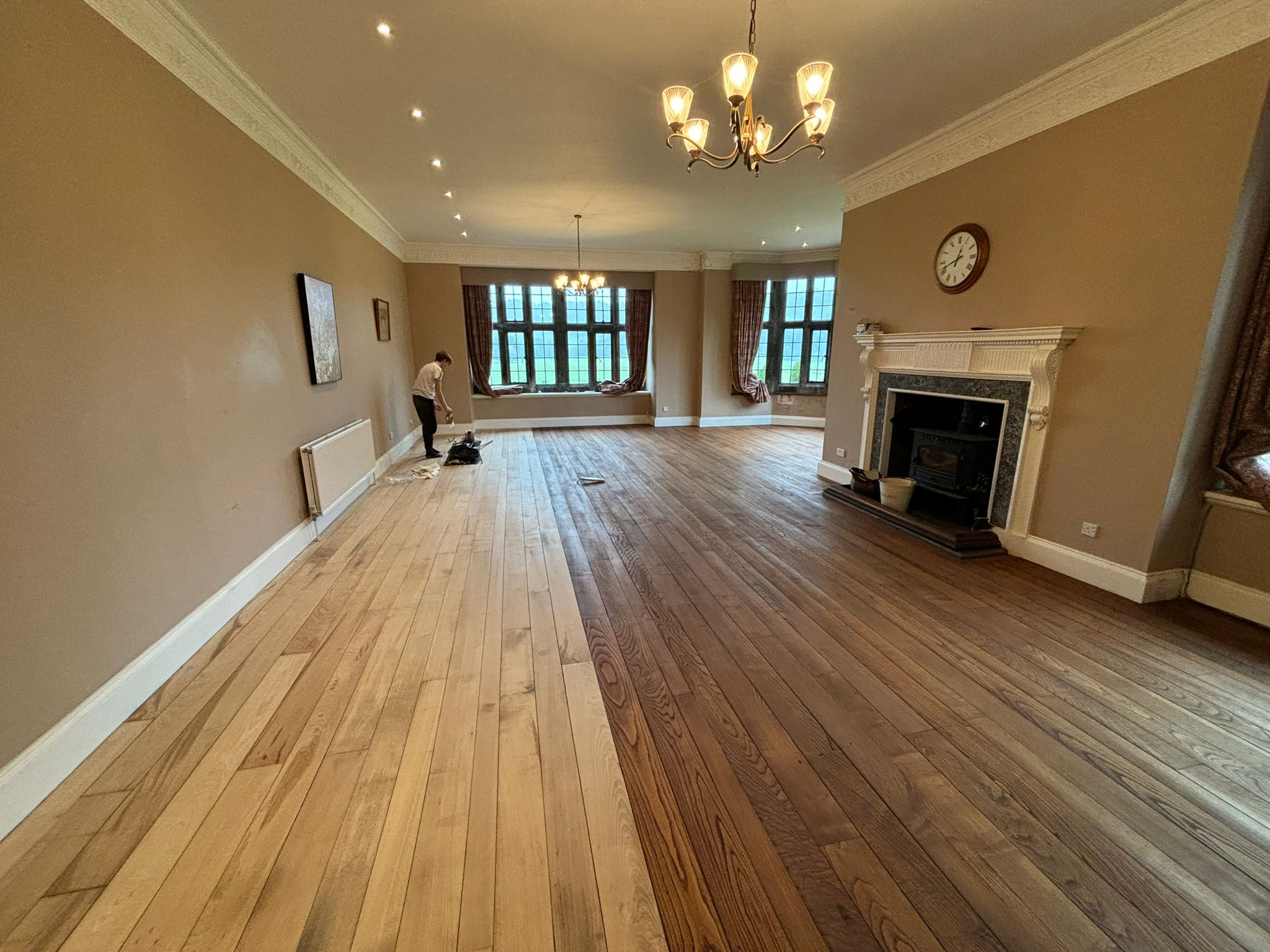
Some of the oldest domestic floors in this part of Sussex are a short walk from Horsham’s market square. The Causeway, the lane that runs down to the parish church, keeps a run of timber-framed houses from the early seventeenth century, one of them carrying the date 1615 beneath its roof of heavy Horsham stone slabs. Upstairs in buildings like that, floors are seldom flat. The frame has shifted over four hundred years, joists have sagged under the weight of that stone roof, and the boards themselves may be oak or elm planks wider than a hand span, fixed with nails a blacksmith made. Floor sanding in Horsham’s older houses is less about how much timber can come off than about how little.

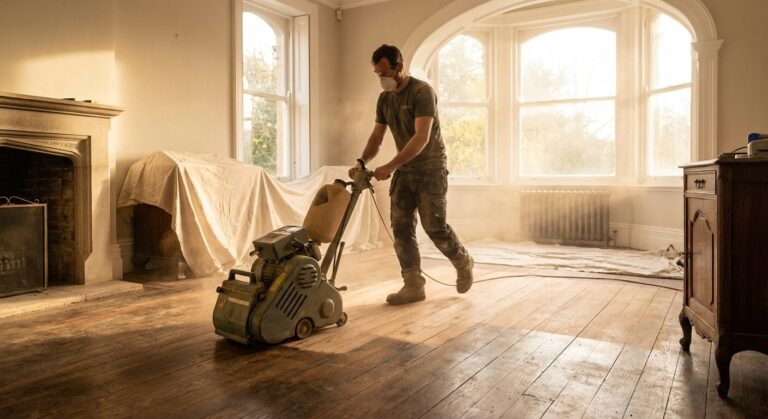
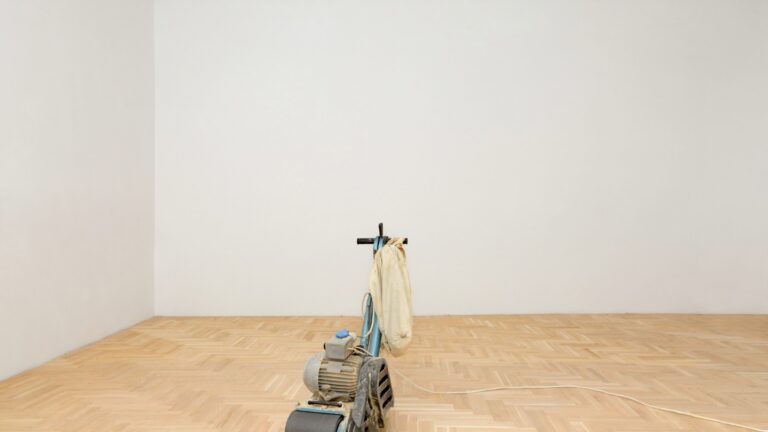
That changes the equipment. A heavy drum machine wants a level surface; set it down on an undulating oak floor and it will bite into every crown and skate over every dip, leaving the hollows grey and the high points stripped raw. On a floor with real movement in it we use lighter machines that ride the contours, start on a gentler abrasive, and stop as soon as the dirt and broken finish have gone, so the dips and the darker wear by the hearth survive. Occasionally the better answer is no machine at all, just a deep clean and fresh wax over the old surface; on boards this old, gentle wood floor restoration often beats a full sand. Our floor sanding page describes the conventional sequence; in a house of this age we treat it as a starting point and adjust.

For listed buildings the owner deals with consent, and we can write the proposed treatment down in plain terms for the conservation officer to read: which boards stay, how they are cleaned, what goes on top. Where oak has shrunk and twisted, restoring old oak usually means accepting a few open joints rather than forcing the boards together.

An honest note on distance. Our family firm works out of Higher Poole near Wellington, in the west of Somerset, and getting to West Sussex takes most of a morning on the A303 and beyond. Horsham is therefore occasional territory for us, taken on for larger house projects, several rooms of period boards for instance, and for commercial floors. The places we work in week in, week out are listed on our coverage page.
Family Homes Around Horsham: Victorian Pine, Teak Parquet, Engineered Boards and Stairs

Move away from the medieval core and Horsham’s housing shifts through every era of the last hundred and fifty years, and so do its floors. Victorian and Edwardian villas off the main roads usually have pine boards under the carpet. Post-war semis and bungalows often have woodblock in the hall and lounge, and a surprising amount of it is teak or another oily tropical hardwood rather than oak. The newer estates on the edges of town are mostly engineered boards or click-fit floors laid in the last twenty years.

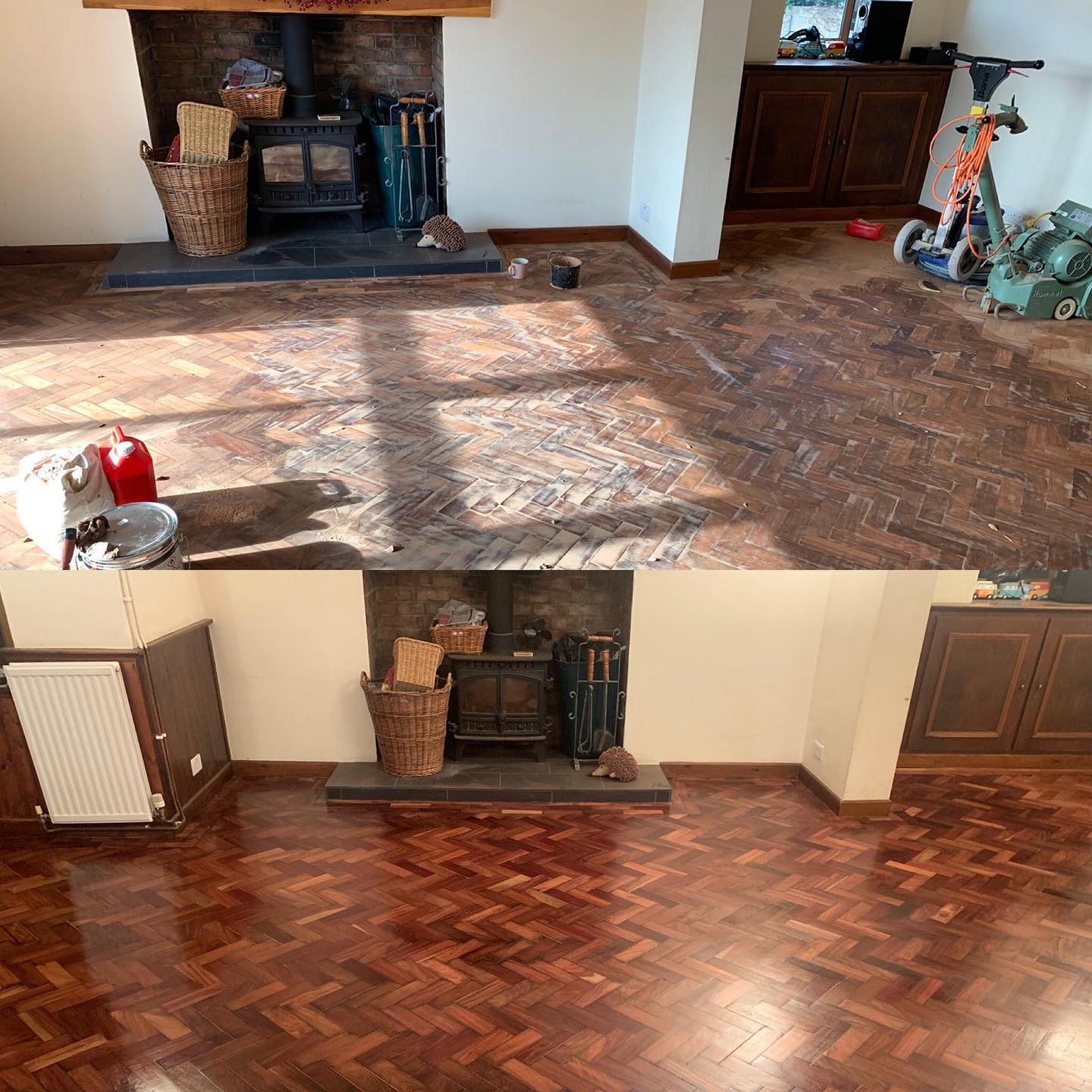
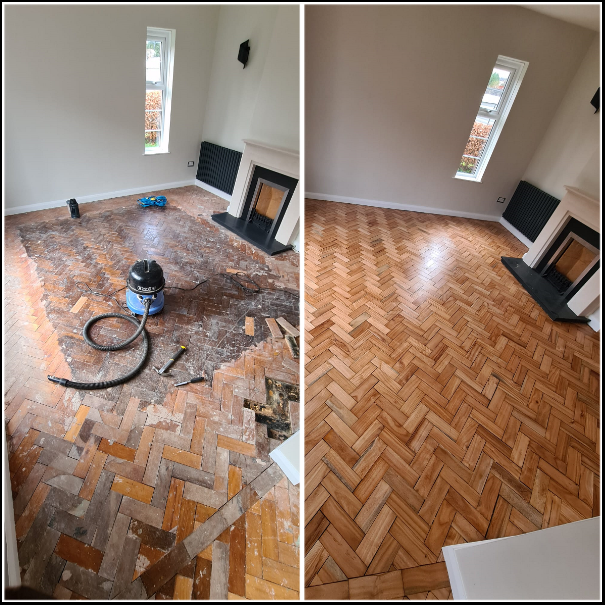
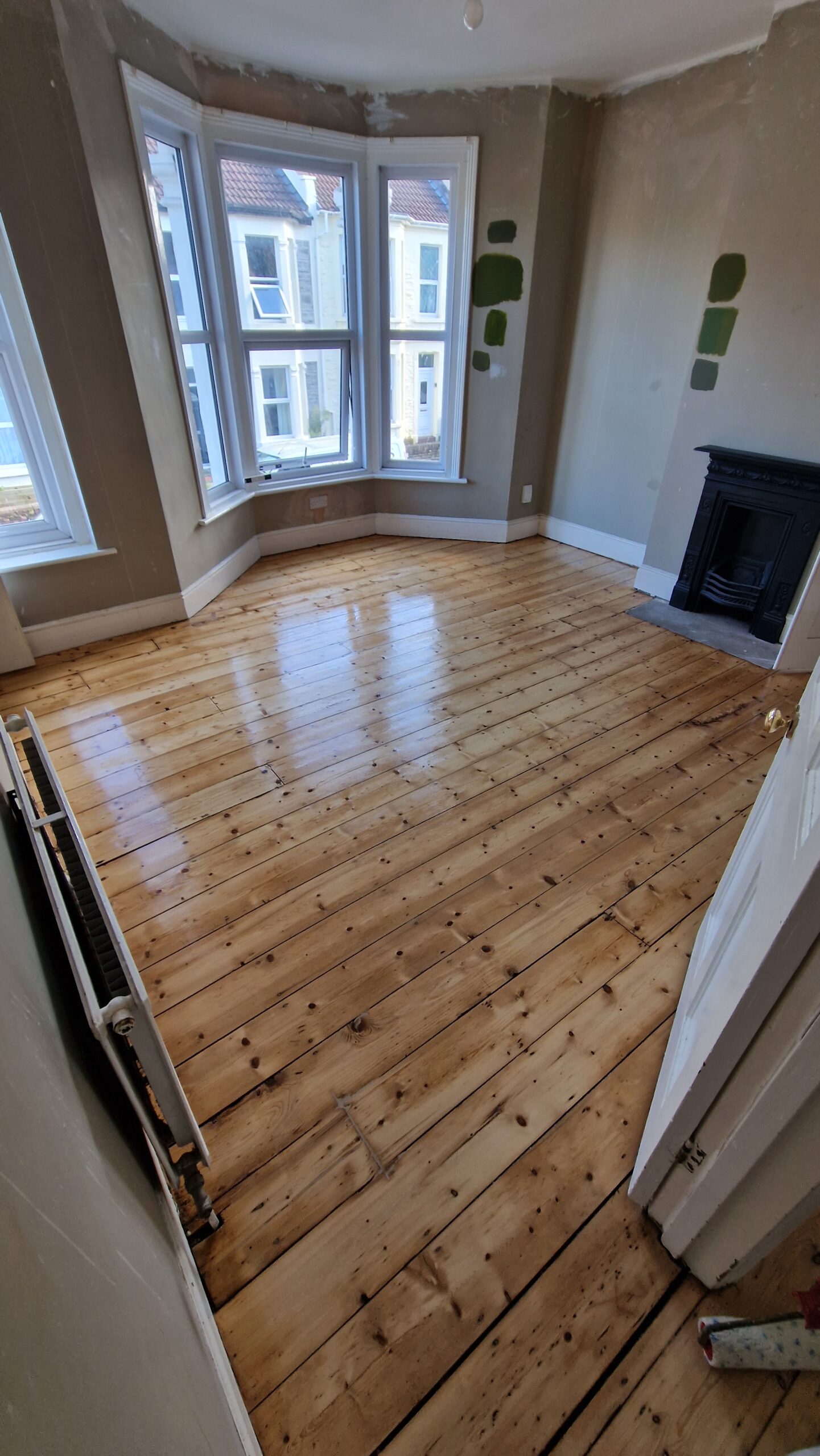
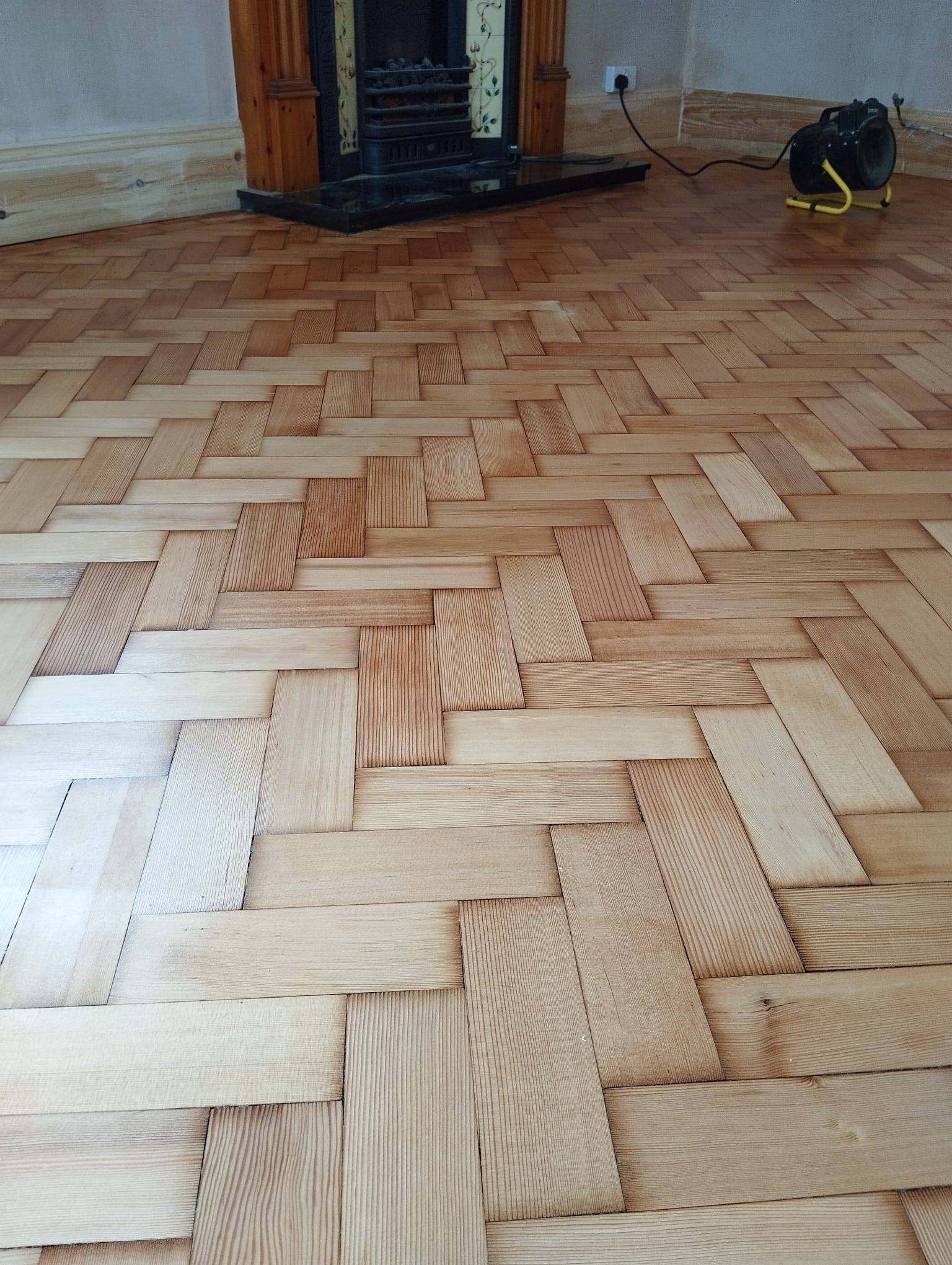
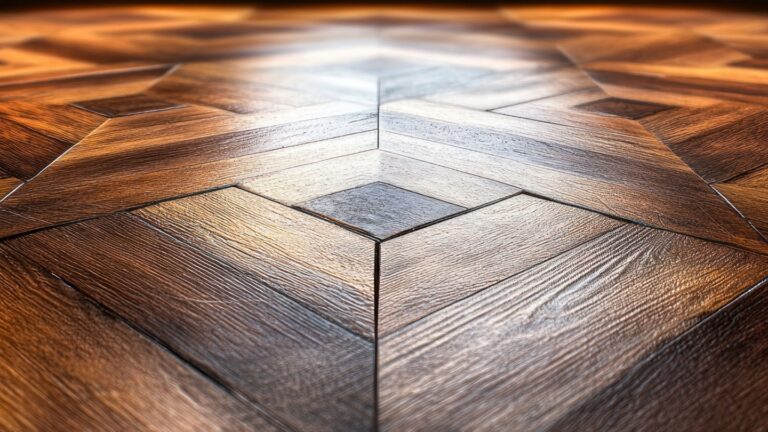
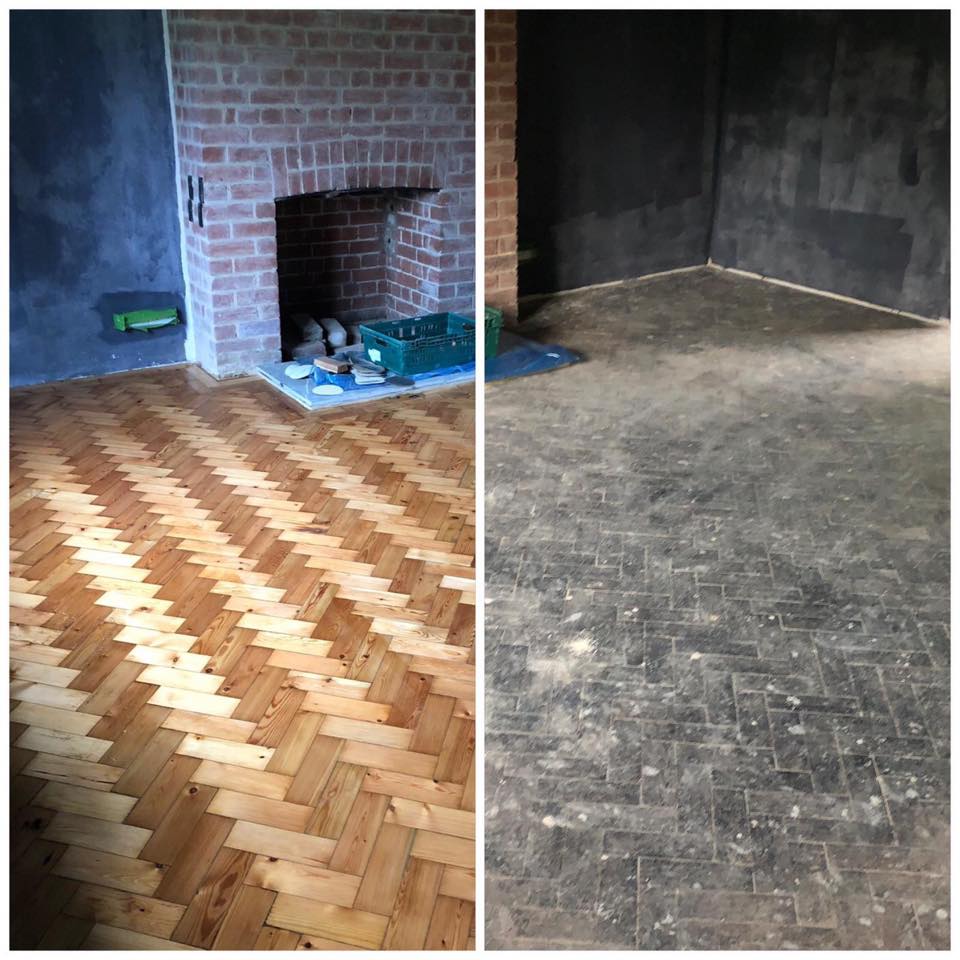
Each needs a different first question. With Victorian pine, it is how many times the boards have been sanded before and whether the tongues are still covered. Pine floor restoration on boards that have never seen a machine is straightforward; on boards sanded thin in the 1980s it calls for a lighter hand. With teak parquet, the issue is the natural oil in the wood, which can slow some lacquers from curing and stop others bonding properly. Wiping the freshly sanded blocks with a solvent just before the first coat, or choosing a finish made for oily hardwoods, gets round it. Blocks that have lifted from their old bitumen bed are taken up, cleaned and glued down again before any sanding, and parquet floor sanding covers how herringbone parquet is sanded on the diagonal so the grain is not torn.

Engineered floors are where people most often ask whether sanding is even possible. Think of each plank as layered: real oak, or another hardwood, forms the visible face, and beneath it sits a plywood or softwood carrier. Only the face can be sanded, so its depth is the whole question. On floors from recent decades it varies roughly between 2mm and 6mm. A threshold strip or a floor vent will usually reveal a cut edge where it can be measured. Three millimetres or more generally allows a full sand at least once. Thinner veneers can sometimes take a very light pass to remove scratches, and some cannot be sanded at all. Click floors with bevelled edges present a further choice: sanding the face flat removes part of the bevel, which changes how the floor looks, so it is worth deciding beforehand. Laminate is a photograph of wood under a resin skin; no abrasive will ever improve it.

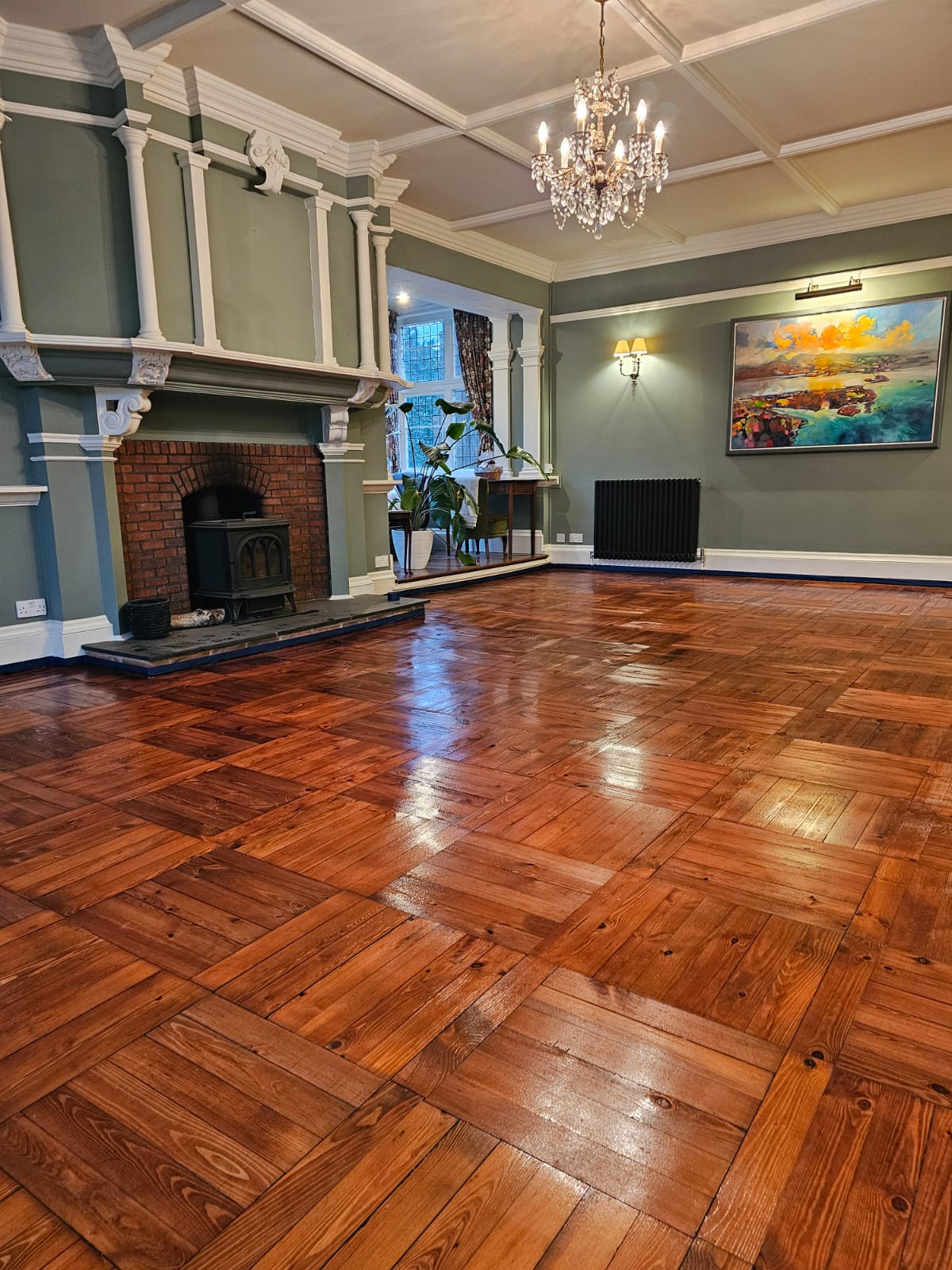
Staircases in these houses range from steep cottage flights to open-tread oak in a modern hallway. Removing a carpet runner leaves rows of tack holes and a band of untouched colour down each side, and stair sanding deals with both, tread by tread, keeping the nosings rounded and crisp. Across all these house types, wood floor restoration in Horsham is a negotiation between how much sound timber is left and how hard the family uses the room: a hallway with two spaniels needs a different plan from a guest bedroom. Our wood floor restoration page runs through everything from a single patched board to stripping and refinishing a whole storey.

Floor sanding south east London
Commercial Hall Floor Refurbishment

Commercial Floor Sanding in Horsham: Pubs, Restaurants, Shops and Studios

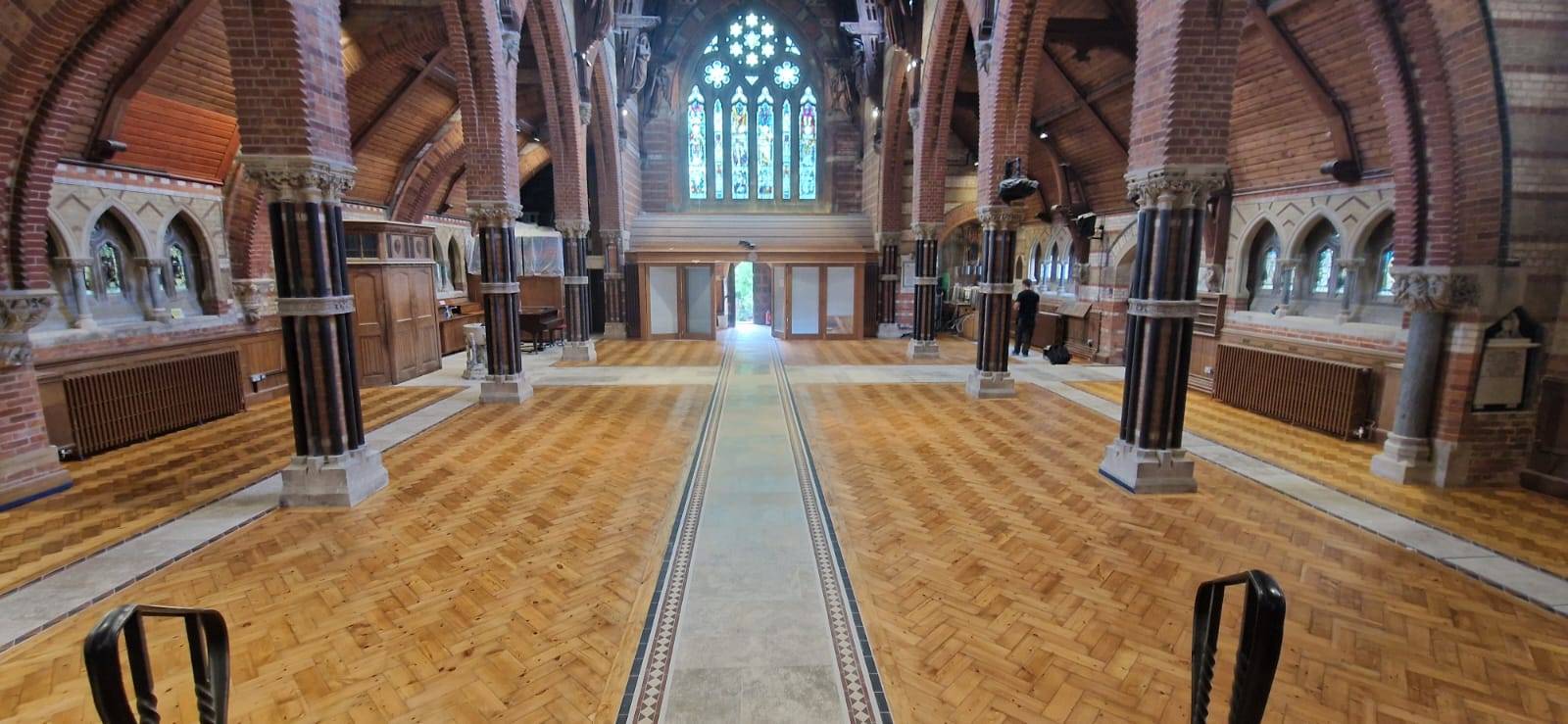
Horsham’s town centre has a good number of pubs and restaurants in older buildings, many with boarded floors that take a pounding from chair legs, spilt drinks and the grit carried in on wet evenings. Commercial floor sanding in Horsham for that kind of premises is nearly always overnight work. Sanding starts after the last customers leave, the floor is taken back to bare wood in sections, and fast-curing lacquer goes down in thin coats so the room can reopen when the staff arrive. A bigger bar may be split across two or three nights, with the seating area done first and the bar run last, so a part of the room is always usable. More detail on organising work around opening hours sits under bar and restaurant floor sanding.

Sheen matters more in a pub than people expect. A high-gloss floor shows every scuff and can feel slippery when someone walks in from the rain with wet soles, so a satin or matt two-pack lacquer is usually the sensible choice, and an anti-slip additive can be stirred into the final coat where the floor runs up to an outside door. Two-pack lacquers cure to a much harder film than single-pack ones and hold up far better to drinks being mopped off several times a night.

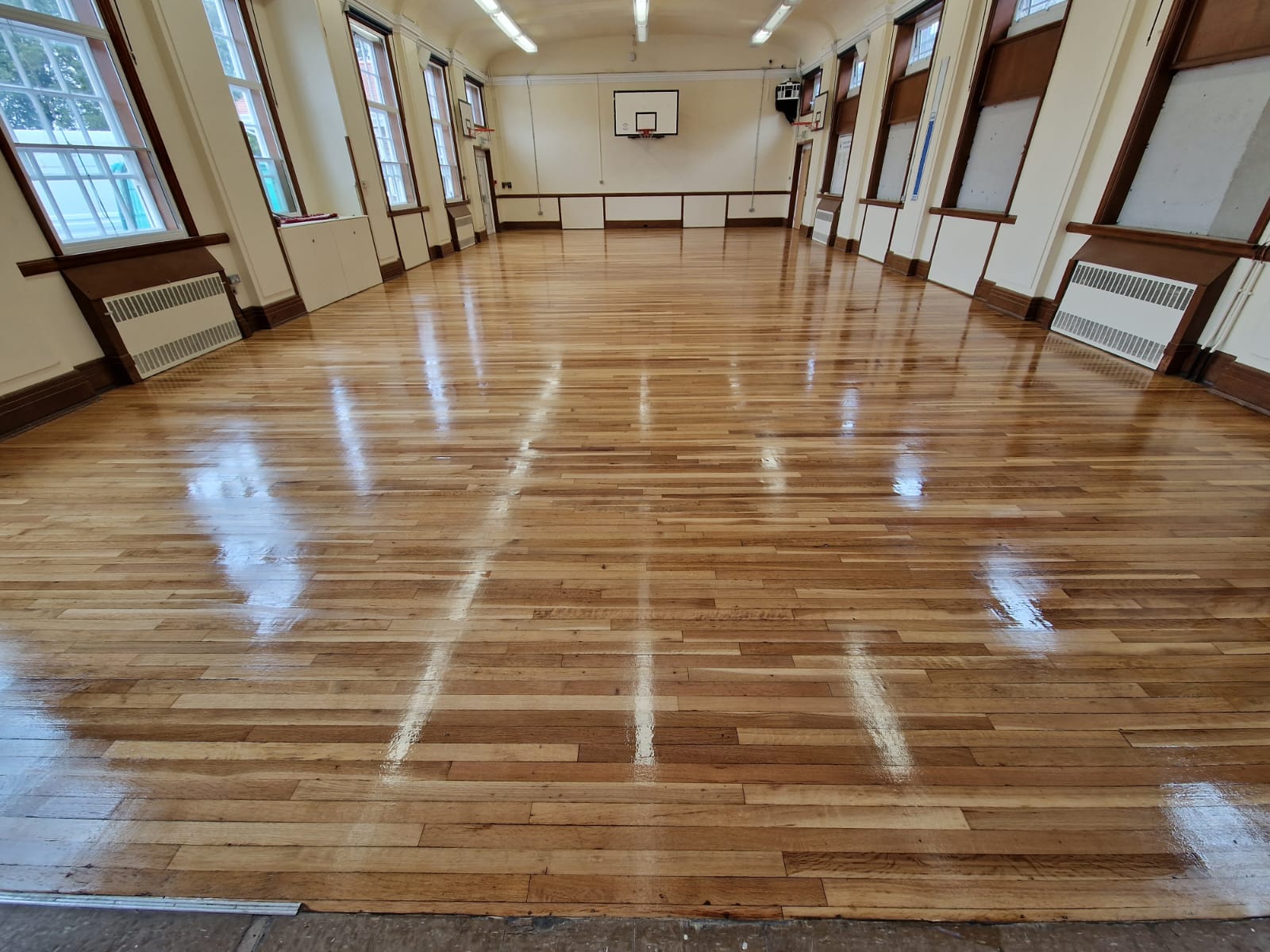
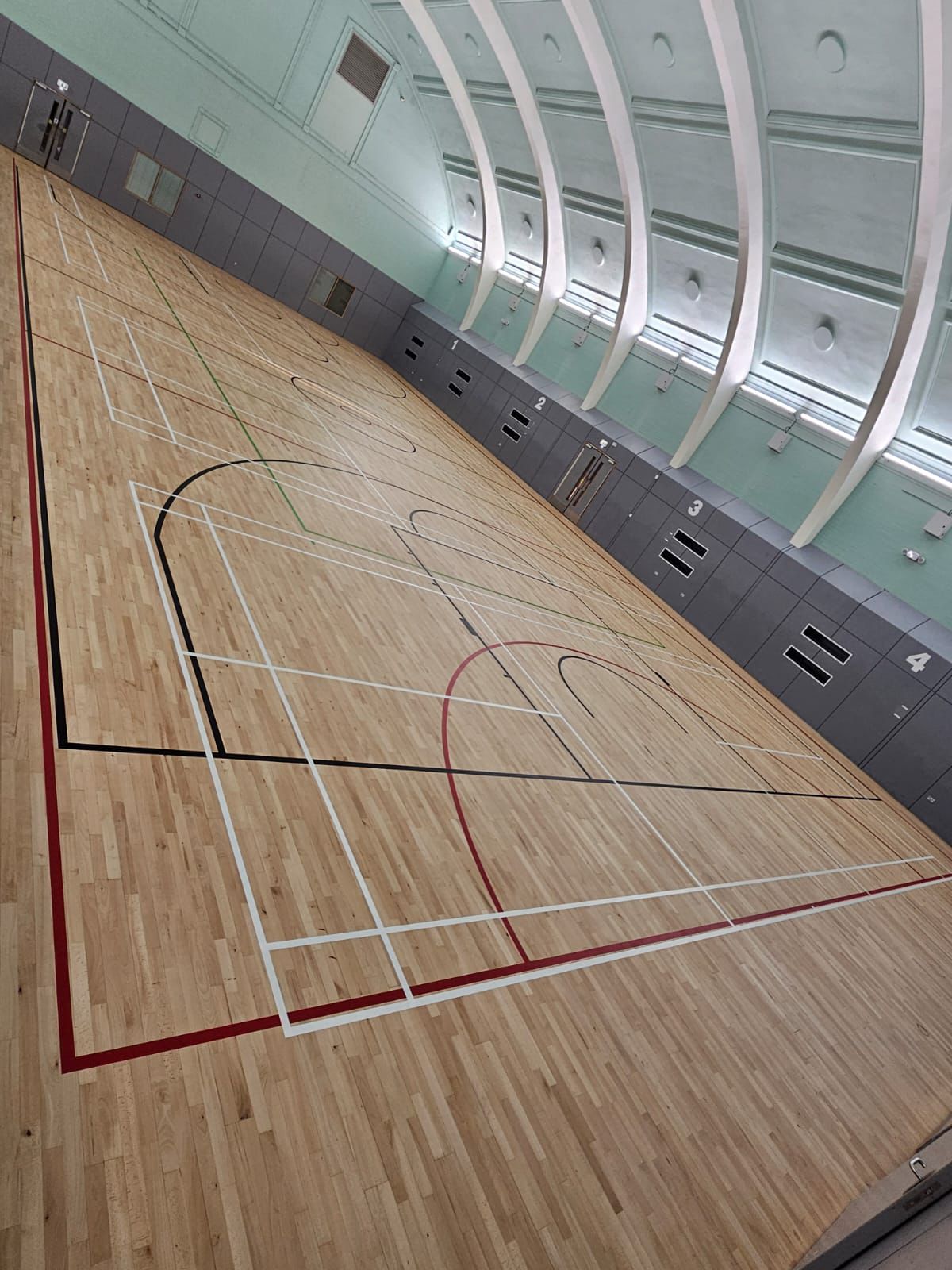
Shops have their own pattern of wear: a dull, grey track from the door to the till and round the main display, with the corners almost untouched. Shop floor sanding is usually fitted into a Sunday or after closing, sanding the whole floor so the worn route does not show up as a different colour afterwards. Dance and yoga studios have the opposite worry, grip rather than wear, and a satin finish that lets a foot turn without skidding is covered under studio and dance floor sanding. For a school, the long summer break is the natural slot, and the badminton or netball markings are repainted by our own team to whatever dimensions the sport’s governing body lays down; school floor sanding has the detail.

Because Horsham is a long way from our Somerset base, commercial jobs here are planned as one continuous block of nights or shut days rather than spread across separate visits. Managing agents who need a written method of work or sight of our insurance before granting access can have both. The approach for every type of premises is set out on the main commercial floor sanding page.

Chipboard Patches, Creaking Boards and Draughty Joints in Horsham Houses

One of the most common finds when carpets come up in Horsham’s older family homes is a square or two of chipboard. It usually dates from a central heating installation, when pipes were run under the floor and the plumber found it quicker to cut out a section of boards and screw down a sheet of whatever was handy. Chipboard cannot be sanded or finished to look like wood, and it often sags between joists. It comes out, the joists are checked and packed level if needed, and boards of matching width and thickness go in, preferably reclaimed ones that have had decades to darken. Replacing floorboards in this way is fiddly, especially where pipes run directly underneath, but once sanded alongside the original boards the patch should be very hard to spot.

Creaks in old houses are rarely mysterious. Stand on the noisy spot and the board dips a fraction; that flex lets the old cut nail rub inside its hole, and the rubbing is the squeak. In a floor that also slopes, which many Horsham cottages do, there may be a sagging joist or a missing strut as well. A board can be screwed down with the head sunk below the surface, and a joist can be stiffened from beneath if the void allows. The slope itself is part of the building and is generally best left alone, as levelling it would mean far more disruption than sanding warrants. Fuller detail on silencing noisy floors is under creaking floor repairs, and the wider list of jobs we take on, from split tongues to replacing rotted sections near a back door, is on our wooden floor repairs page.

Gaps in pine boards matter for comfort as much as appearance, especially on a suspended ground floor with cold air rising from below. Generous gaps get a slip of softwood planed to a wedge and glued against one edge only, so summer swelling does not crush it. Hairline cracks between boards take a resin paste coloured by sawdust collected during the first sanding pass. Which suits which floor is set out under floorboard gap filling. Deep dents from a dropped pan or a burn by an old fireplace may need a small inlay rather than more sanding, and the options are explained under repairing scratches and dents.

The sanding itself is done with extraction connected to every machine. With dust-free floor sanding, hoses from the sanders feed a sealed collection unit, so the kitchen and bedrooms stay usable while we work next door. Nobody can honestly claim zero dust, and a fine film may reach a high ledge, but it is a small fraction of what an open machine throws out.

Floor Sanding Essex
parquet floor restoration near me

Getting the Colour Right: Stains, Oils and Lacquer Sheen in Horsham

A request we hear often is to make the floor match something else in the house: an oak dining table, a dresser that has been in the family for generations, or a door that has darkened over the years. Matching colour on wood is less predictable than matching paint, and the species of the floor matters enormously.

Oak is the easiest to stain evenly because its grain is fairly uniform in density. It is also rich in tannin, which brings its own surprises. Some water-based products react with the tannin and can give a faint greenish or grey cast, and any trace of iron, from steel wool or a dropped nail left in a damp spot, can turn oak blue-black. Grey and whitened stains, popular in newer homes around Horsham, read very differently on oak with heavy ray figure than on plain oak. Pine is the difficult one. Its soft spring growth soaks up stain while the harder bands resist it, so a dark colour can look striped or blotchy. Finishing the sanding with a finer grit and lightly dampening the surface to raise the grain before staining helps the colour go on more evenly. Some craftsmen call this water popping.

The only reliable method is to try it. Small test patches go down on an area of your own freshly sanded floor, ideally where daylight falls, and are judged with the finish applied, because lacquer and oil both change the shade. The palette of colours we work with is shown on our wood floor staining page.

The topcoat then decides how the floor looks and wears. Water-based lacquers stay clear and pale and suit a light Scandinavian look; oil-based lacquers deepen the colour towards amber. Lacquer sealing in a hallway or kitchen often uses a two-pack product for extra hardness. Oils, including hard wax oil, are absorbed by the timber, leaving a gentle satin look; a worn path by the garden door can be refreshed alone. Products are compared under oiled floor finishes. Wax gives the most traditional look, especially on old oak in a period cottage, but needs regular attention, and traditional wax finishes explains the commitment. If the existing finish is intact but tired, a polish and refresh may be enough without sanding.

After the Last Coat: Care, Fitting and How Horsham Enquiries Work

A new finish feels dry well before it is properly cured, and the first week is when most damage happens. Stay in socks for the first day, keep rugs off for at least a week so the finish can breathe and cure evenly, and leave furniture out for two or three days after the final coat. When it goes back, lift rather than drag it. Felt pads under chair legs prevent most scratches; a doormat at each entrance catches grit before it reaches the boards. Routine care is simple: a soft broom or dust mop most days, and now and then a mop wrung almost dry, dipped in a cleaner designed for finished wood with a neutral pH. Steam mops should never be used on wooden floors.

Over time, even a well-kept lacquer starts to dull in walkways. A machine clean followed by a fresh maintenance coat can restore it before wear reaches bare wood, and that service is explained under floor buffing and recoating. Treated like that, the boards in a family house can go the better part of a decade, roughly eight to ten years, without needing the sanders again, whereas a bar or shop will be due after about half that.

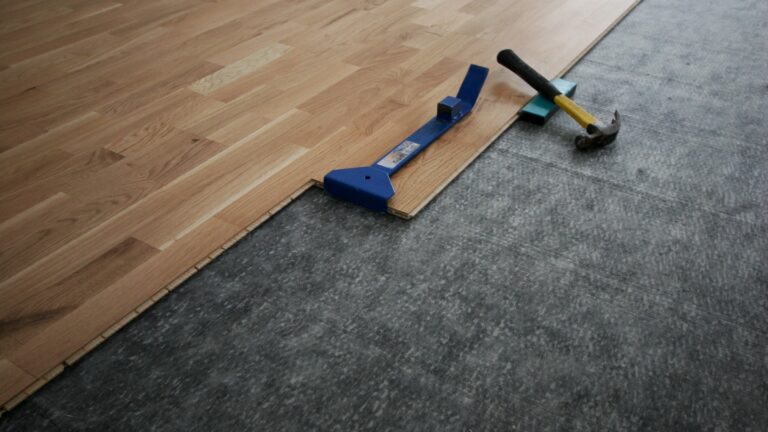
Occasionally the old boards are too thin or rotten to keep, or an extension has only a screed. We also supply and fit new floors, solid or engineered, or supply boards for another fitter, with manufacturers including Junkers and Bona among the ranges. Boards should be brought into the house to acclimatise before fitting, and the subfloor must be dry and level. More is on our wood floor fitting page.

The quickest start is two pictures on a phone: the whole room seen from where you enter, and a tight shot of the scruffiest boards. Send both with your postcode, and we will say whether the floor looks suitable for sanding and what preparation is likely. Where it makes sense to visit, a free half-hour survey follows: a meter on the boards for moisture, a look at how much wood remains above the tongue, the state of the airbricks and any earlier botched repairs. You then receive a written quotation with each element listed separately, which stands unless the job changes. Use the website contact form to attach the pictures, or email them to info@ryansrestoration.co.uk. Phone enquiries reach us on 01823 674562 from 8am to 6pm, Monday through Friday.

Parquet Flooring Restoration

Horsham Floor Sanding Questions

Not regularly. Not as a matter of routine, because home for our family business is Wellington in Somerset, a long way west of the Sussex Weald. The trip is worth making for something substantial, a ground floor of Victorian pine or a run of oak rooms in a timber-framed house, and for business premises such as bars, shops and halls. Send photographs and we will tell you whether the project fits.

In most cases, yes. We arrive as the last glasses are collected, take the boards back a section at a time, and lay quick-curing lacquer that has hardened by the time the lunchtime shift arrives. A big pub can be phased across a few nights so some tables are always available. A satin or matt two-pack lacquer is the usual choice for durability and grip.

Usually, yes. Creaks are generally loose boards and can be fixed by screwing them down, or by stiffening a joist from below if access allows. The slope is part of an old building and is normally left as it is. Sanding is done with lighter machines that follow the floor’s contours rather than flattening it.

Yes, with care. The aim is to remove dirt and failing finish while keeping as much of the original surface and its patina as possible. That means gentle abrasives, lighter machines and stopping early. Sometimes a deep clean and re-waxing is better than sanding at all, and we will say so if that applies.

It is. Teak contains natural oils that can slow some lacquers from curing or stop them bonding properly. The freshly sanded blocks are wiped with a solvent just before finishing, or a product designed for oily hardwoods is used instead. Teak also darkens noticeably under any finish, so it is worth testing a small patch first.

We can get close, but wood is never as predictable as paint. Test patches are applied to your own sanded floor and judged with the topcoat on, in that room’s daylight, because lacquer and oil both shift the colour. Oak takes stain evenly; pine is harder and needs extra preparation to avoid a blotchy result.

Yes. The chipboard is removed, the joists checked and packed if needed, and timber of matching width and thickness is fitted in its place, reclaimed where possible so it already has some age. After sanding and finishing alongside the original boards, the repair should blend in closely with the rest of the floor.

Oiled floors are among the easiest to repair locally. The scratched area is lightly sanded by hand or with a small machine, then re-oiled and blended into the surrounding surface without touching the rest of the room. Deeper gouges may need a little filler or a small inlay first. Lacquered floors are harder, as patches can show.

Begin by sending us two images: one taken from the doorway showing the room as a whole, one taken low down over the tired boards. Add how many rooms and where in Horsham. For a project worth the journey, a free survey of around thirty minutes comes next, then a written quotation that lists each stage of the work. The address is info@ryansrestoration.co.uk and the office number 01823 674562.